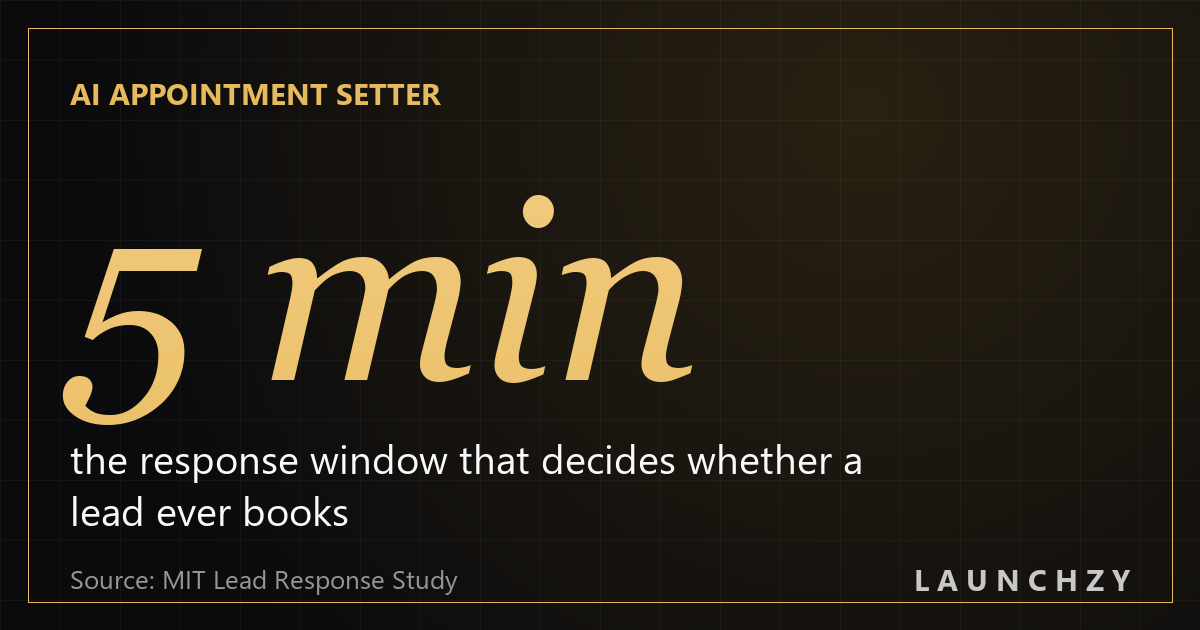
There's a single number that quietly decides whether a new lead ever becomes a booked appointment: how many minutes pass before someone follows up.
A lead fills out your form or clicks your ad. The clock starts. And according to research out of MIT, what happens in the next few minutes matters more than almost anything you'll say once you connect.
What MIT found
The Lead Response Management Study, led by Dr. James Oldroyd (then at MIT Sloan School of Management), analysed thousands of leads and millions of call attempts. Two findings stand out:
Contact a lead within 5 minutes instead of 30 and you're roughly 100× more likely to reach them, and 21× more likely to qualify them. Wait 30 minutes and, statistically, the lead has already moved on — filled out three other forms, or booked with a competitor.
Why almost everyone breaks the rule
The 5-minute window collides with real life. You're on a job, in a meeting, or asleep. The lead came in at 9pm or on a Saturday. By the time you circle back the next morning, the moment's gone. Study after study of inbound leads finds average response times measured in hours or days — not minutes.
It's not a discipline problem. No human team can reliably call every new lead within five minutes, around the clock, forever.
Speed you can't fake manually
That's the entire point of Launchzy's AI Appointment Setter. It calls and texts every new lead within minutes — day or night — qualifies them in a natural conversation, and books a confirmed appointment straight onto your calendar. It doesn't sleep, take lunch, or get busy, so every lead gets the 5-minute treatment the research says wins.
Your competitors are still "getting back to leads in the morning." That's the gap.
Respond to every lead in minutes
See how an AI Appointment Setter would call, qualify, and book your leads — automatically.
Book your free audit call →Source
- Oldroyd, McElheran & Elkington, "The Lead Response Management Study" (MIT Sloan / InsideSales), summarised in Harvard Business Review.